Showing posts with label creative writing. Show all posts

Tuesday, May 5, 2020

If this isn't nice, I don't know what is!

I've had this quote on my blog wall since 2008:
"I urge you to please notice when you are happy, and exclaim or murmur or think at some point, 'If this isn't nice, I don't know what is.'" 

Such serendipity to hear the author speak the words, when I came across this Kurt Vonnegut lecture on the Shapes of Stories.  His Uncle Alex would frequently say them aloud at family get togethers. A viral-worthy phrase. Infectious gratitude!

The lecture on the Shape of Stories was humorous as well as a unique way of mapping the arc of a character's journey.


The straight line on the graphic above is Vonnegut mapping Hamlet and remarking on how the genius of Shakespeare is the lifelike ambiguity that keeps us from knowing whether developments are "good" or "bad." He did stop short of quoting the famous line, "for there is nothing either good or bad, but thinking makes it so."

Which is why it IS so important to notice when you are happy, and exclaim or murmur, "If this isn't nice, I don't know what is."

Tuesday, November 5, 2019

Writing Wild Literary Festival 2019


Janine and I attended the Wild Writers festival for the second time this year. So much inspiration in one weekend.

As a kid I I wanted to grow up to be either a saint, an astronaut, or a writer. As an adolescent I wrote poetry, in college it was screenplays. I enjoyed the discovery and self-expression but was daunted by the thought of earning a living by the pen, especially when I learned so many struggle to pay their rent and buy their groceries. Creative writers  became mystical creatures, beings set apart.

Instead of creative writing I have become an appreciative reader, and whenever I go to a literary lecture with the author in attendance I'm in awe of their tenacity and ability to get the book published. What a journey!

And there are so many books on shelves these days, I know it is impossible to read them all, however much I would like to.

Literary festivals are one way of tasting what's out there, and at Wild Writers this year,  I attended three panels:the Opening Showcase, Character Reinvention in Fiction Writing, and the Literary Brunch. The authors read from their books, each voice distinctive. I had the pleasure of hearing
  • Elizabeth Hay: All Things Consoled
  • Kathy Page: Dear Evelyn
  • Philip Huynh: The Forbidden Purple City
  • Nadja Lubiw-Hazard: Nap Away Motel
  • Casey Plett: Little Fish
  • Jessica Westhead: Worry
  • David Bezmogis: Immigrant City
  • Michael Crummey: The Innocents
  • K.D Miller: Latebreaking

I swore I wasn't going to buy any more books! Still, I couldn't resist. And so many new titles added to my 'Want to Read' list.

When I was younger, I remember being seized by an idea or needing to get things out and on to paper. Waiting for inspiration to strike isn't necessarily as effective as dedicating time and demystifying the process.

I DO plan on finding time for creative writing in the near future, but right now, insights into the writers' craft make me appreciate the magic and power of language all the more.

At the Opening Showcase, Hay and Page talked about how they wove personal experience into both memoir and fiction. How there is a bit of fiction in the best memoir, and truth in fiction.

Casey Plett shared Steven King's advice to "Write with the door closed, edit with the door open." Others agreed that it is important just to get the thoughts out and on paper, editing can come later; but if you edit yourself before you even start there won't be any material to work with.

Facing Your Fear of Poetry with Sarah Tolmie was eye-opening. She broke us into groups of four, and gave all of us the same instructions to create a braid with three lengths of rope. Our own little group experimented with different approaches for a tight braid, while others discovered a more rhythmic dance. After about twenty minutes or so we placed our creations on the floor. Each so different!

Sarah went on to say that what we had created was a simple text... 'text' literally means woven; the braid is motion captured. Each of us then wrote a poem about our individual experience, then we collaborated to create another.

Unfortunately, when people read the poems aloud, I couldn't hear them entirely well, but the impression was made. There were beautiful phrases that somehow transcended experience.

Also the concept ekphrasis arose when some late arrivals were asked to write poems about what they saw laid out on the floor, rather than their experience in creating them. Very cool... "in this way, a painting may represent a sculpture, and vice versa; a poem portray a picture; a sculpture depict a heroine of a novel; in fact, given the right circumstances, any art may describe any other art..." 

Creating Character with Kathy Page was a straightforward exercise in building a character, thinking about what they look like, what they wear, what they think about, fear, love. Some authors work out all the plot details and then set characters within the arc, others assemble the characters first and then let them spark the story. What is the worst thing that could happen to your character right now? Thinking about those difficult people we come across in our lives.... what made them so?

Nothing to write about? There really is no shortage of raw material.


Sunday, January 27, 2019

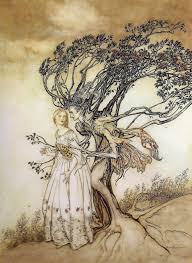
Here's to old ladies!

illustration from The Old Woman in the Wood
[Grimm’s Fairy Tales] by Arthur Rackham
Mary Oliver, Ursula K. Le Guin, and Diana Athill are preeminent women who shared the fate of dying this past January. I've heard their names for decades and revered their literary success. Now I appreciate them not only for their writing but for living well into their old age.


"If I'm no good at pretending to be a man and no good at being young, I might just as well start pretending that I am an old woman. I am not sure that anybody has invented old women yet; but it might be worth trying."

This is from Ursula K. Le Guin's original piece 'On Being a Man,' which I stumbled across on Brain Pickings. I would have liked to see Le Guin's original performance of it when she was 60. So brilliant! And Le Guin went on being brilliant until she died last week on Jan 22 at the age of 88.

Diana Athill also died last week, on January 23, at the age of 101. The memoirs she wrote in later life include frank accounts of her sexual escapades and love affairs. Speaking to the Guardian in 2017 as her 100th birthday approached, Athill said she had been lucky in her life, adding that “things have come out so well for me that I’ve been able to have a very relaxed philosophy, which is enjoy yourself as much as you can without doing any damage to other people … I can’t think many centenarians are still living by their pen.”

And also this week, an Opinion piece in the Globe and Mail celebrated the creativity of late bloomers, especially women, in Create Til you drop, and other lessons from late Bloomers 
Has there ever been a more suffocating phrase than old lady? It is a pillow to murder ambition, historically. But perhaps not anymore, as we choose new directions for these long, long lives. Maybe we can take back the phrase, break it and shape it anew. Old lady painter. Old lady writer. Old lady, victorious. Elizabeth Renzetti

My yoga teacher Marlene is into her 81st year, and I took a workshop with her Saturday morning, well attended by 50 students and teachers seeking her wisdom and advice.

I am also lucky to count many older women as my friends, such as Grace, who organized a fantastic Robbie Burns supper that was attended by more than one hundred guests, just last night. Rob emceed and I was privileged to sit at the head table in one of the best seats to enjoy the proceedings.

Old ladies? Vital leaders and shapers of community and thought. I am happy to be under their influence.


---


Create Til you drop, and other lessons from late bloomers
by Elizabeth Renzetti
illustration: Hanna Barczyk

When I visited Diana Athill in her north London flat in 2009, she had just become a literary star at the age of 91.Her memoir, Somewhere Towards the End, was a surprise bestseller; it would go on to win Britain’s Costa biography prize. We trudged up four sets of stairs to her apartment, and I would have had more trouble than Diana if we’d been asked to inflate a paper bag at the top.

We sat down to talk about her extraordinary life as an editor at the publishing house Andre Deutsch, where she’d been the midwife to writers as different as Jean Rhys and Mordecai Richler. We talked about aging and sex and mortality, the subject of Somewhere Towards the End. The British press seemed shocked at how candidly Ms. Athill had written about her lovers – she would count them like sheep when she wanted to go to sleep. She wrote with sadness about how her flesh no longer felt sexual desire, and yet she told me, briskly, how grateful she was that all other systems were functioning: “No dementia, thank God, and no incontinence.”

Ms. Athill, who died this week at 101, would go on to publish four more books, including another memoir, Alive, Alive Oh! The books she wrote in her 10th decade brought her more success than the ones she had written when she was a younger woman. She was like a clock in reverse, not winding down but speeding up.

She had told me she was lazy, and we bonded over this shared affliction, but I’m not sure the evidence supported her claim. I added her to my list of heroes who came into their creativity late in life. In my head I named this file, “You’re not dead yet, so you might as well pick up that pen.” It included Annie Proulx, who published her first work of fiction at 53, Frank McCourt, who was 66 when Angela’s Ashes came out, and a surprisingly (hearteningly) long list of other writers who only found their feet when their peers were falling off their bar stools.

At the top of that list, of course, is the peerless Penelope Fitzgerald, who wrote her first novel as a story to entertain her dying husband and published it at the age of 60. Over the next 20 years she would write eight novels, culminating in her masterpiece, The Blue Flower, when she was 80. Her middle years were marked by poverty and hardship, her late ones by a creative blooming that caught the public by surprise. Shouldn’t this charming elderly lady be at home knitting? Clipping coupons? Organizing village fêtes? Instead, she unfurled on the page what she’d been containing her whole life.

This is a subversion of cultural norms; very few magazine stories are written about the latest hot old thing. But these success stories are an inspiration to late-starters, zigzaggers, and others who discover that the bit of life where they were meant to slow down is the bit where they choose to run. Retirement now lasts 20 or 30 or 40 years; there’s only so much golf you can play.

Canadian writer Katherine Ashenburg was 72 when she published her first novel last year, the wonderful Sofie & Cecilia, which is about two women in early 20th-century Sweden whose ambitions are thwarted when they marry famous artists (full disclosure: Ms. Ashenburg is my former boss and a friend.) “One of the things I really wanted to write about was two women who flowered in old age,” Ms. Ashenburg told me. “Which I think can happen especially to women, once their domestic responsibilities lighten up or are gone entirely. Housework and mothering give you a lot of time to think up stories and to mull things over.” The last section of the novel, when the two women age into the dreams and work once denied them, is called Red, “for great sunsets, for passion in love and work.”

This late creativity can come at a price. As Nell Irvin Painter recently said in an interview with NPR, “being old in our society – it’s not for sissies.’’ Dr. Painter, a professor of history emerita at Princeton University and author of the bestseller The History of White People, found this out the hard way when she decided to pursue her early-life passion for painting and enrolled in a fine arts degree program.

She was 64 at the time, a number so vast and unimaginable that it elicited a gasp of shock from a fellow art student (very young) who asked “How old are you?” The anecdote is contained in Dr. Painter’s book Old in Art School: A Memoir of Starting Over, which has just been nominated for a National Book Critics Circle award.

It isn’t just the young woman’s shock, either. As she works her way through an undergraduate, then graduate degree in fine arts, Dr. Painter has to contend with all kinds of ageism, from the sense that she looks wrong (comfortable shoes, baseball hat) to one teacher’s dismissive claim that she lacks the “right nowness” that the art world seeks. “All the better to die young,” she writes with martini-dryness. “Too late for me.”

She had been reduced to one label: ”It wasn’t that I stopped being my individual self or stopped being black or stopped being female, but that old, now linked to my sex, obscured everything else beyond old lady.”

Has there ever been a more suffocating phrase than old lady? It is a pillow to murder ambition, historically. But perhaps not any more, as we choose new directions for these long, long lives. Maybe we can take back the phrase, break it and shape it anew. Old lady painter. Old lady writer. Old lady, victorious.

Monday, November 5, 2018

Writing Wild

I reconnected with an old friend this past summer via Linked In. Janine lives in Waterloo and while staying with my mother I popped by a few times to catch up.

We were high school poets and won some awards and recognition in our senior year, however we've both gone on to different careers to earn our living. I still love words, but haven't been doing much creative writing over these last decades.

So when Janine suggested we attend the Wild Writers festival, I thought it would be the kick in the pants I needed to write a few pieces, and bring them to the festival as works in progress.

I creatively avoided doing any creative writing and although I didn't have any works in progress, I was still happy to attend the festival as a poser.

Janine's invitation included a weekend stay at her condo, just a short walk away from the festival location, the Centre for International Governance and Innovation. CIGI is a great venue space, with a fantastic stage and lots of boardrooms and lecture halls for discussion and exploration.

The opening showcase  featured Sharon Bala and Rawi Hage in a panel moderated by Jael Richardson. When it turned to practical advice for new writers, both authors declined, which was a bit disappointing. However, the two workshops I attended the next day had lots of great tips for those aspiring.

The Creative Nonfiction workshop was with Jael, and she confirmed the importance of calling to all the senses to lift scenes from the page. She also shared practical advice given to her from Helen Humphries, which is to write from beginning through to the end before you start perfecting drafts. Save each draft as a separate version. Focus on just one or two things when doing your draft (dialogue or character or senses or...). Very useful.


How Research Shapes a Story was a panel with Liz Harmer, David Huebert, Pamela Mulloy, Clare Tacon, and Brent van Staalduinen. Here it was evident that there is definitely no one approach, with each author having a different take on the topic.

Writing Raw: How to Explore Personal Material that is touchy, dark, intimate, tangled, problematic, risky, taboo or downright radioactive was delivered in a very methodical way, which surprised me. First we attacked the question of what subjects made us most uncomfortable, then we listed some of the root causes, and next we read from a handout writer Mike Barnes included with some super-practical writing process tips.  Confronting fears of rejection and separation weren't neglected topics. Although surprised by the methodical approach, I really did appreciate how straightforward and demystified the process could be when deconstructed. It's true the best writing has a magical quality but sometimes we humans have a way of making things more difficult than they need to be.

Janine had signed up for the Poetry Masterclass, Writing New Poems from the Wreckage of the Old.  Participants were to bring books of their favourite poetry along with recent works. During the afternoon they explored techniques such as erasure, cento, glosa and text collages.

The next morning there was a Literary Brunch with Katherine Ashenburg (publishing her first work of fiction in her seventies), Claire Cameron (finalist for Roger's Trust Fiction Prize), and Michael Redhill (winner of last year's Giller prize).  Delicious food, writers reading from their books, and great conversation.

As a result of attending the literary festival, my reading list is now much longer! And I have renewed my interest in creative writing, too... since I don't have to earn a living at it, why not explore it as a means of self expression? The New Quarterly runs an annual contest with the winners announced at the Writing Wild festival. I think I will set a goal for myself to enter a submission in a category (or two). God knows I have enough raw material in the way of life experience.

It was also fantastic catching up with Janine and having a weekend get-together. Next time, to be held in Toronto!