Showing posts with label Music. Show all posts

Sunday, January 11, 2026

And oh the little things, the smallest things

The movie, The Man in the Hat totally resonated with me for its depiction of quirky characters, gorgeous scenery, beautiful music and quiet moments. IMDb calls this a "musically rooted comedy" but that doesn't entirely do it justice. The man in the hat is being pursued and pursuing, driving in his small Fiat through French seaside towns and picturesque countryside. Lots of wonderful scenes, including star gazing, stopping for a picnic, and savouring a traffic jam.

What a fantastic soundtrack! Turns out the director of the film is Stephen Warbeck, the Oscar-winning composer of Shakespeare In Love. 

I loved the movie's music so much I marked it as a Spotify favourite. Memory (The Little Things) by Mathilde, was on the soundtrack but without the lyrics. I tracked it down on You Tube, "The Little Things." 

The song was never officially released, but comments on You Tube prove others were as equally charmed. 

Memory (The Little Things)
Long ago I found my way on the shoreline of the sea
I lost my breath to the birds and the breeze
On the shoreline of the sea

And oh the little things, the smallest things
The little things, remind me of you
And oh the little things, the smallest things
The little things, remind me of you

Long ago I found my way on the shoreline of the sea
The sun was low but my spirits high
The waves wave goodbye to me
What caught my eye was the bird in the sea
Floating honestly away from me

And oh the little things, the smallest things
The little things, remind me of you
And oh the little things, the smallest things
The little things, remind me of you

And now your memory will live on
A little floating one
In the sea.

Friday, December 12, 2025

Little Free Library Divinations

In September 2023, Rob gifted me a Little Library for my birthday and it's been a source of joy and entertainment ever since.

I'm inspired by this post on the Marginalia about Little Free Library Divinations

One day during a challenging season of being, longing for something that would turn my spiraling mind outward, knowing that a daily creative practice has always been my best medicine and that constraint is the mightiest catalyst of creativity, I decided to try applying my bird divination process to the Little Free Library, trusting the lovely way our imagination has of surprising us and, in doing so, reminding us that even in the bleakest moments it is worth turning the page of experience because the imagination of life is always greater than that of the living.

Every day for thirty days, I took a random book from the Little Free Library, opened to a random page, and worked with the text on it, making no aesthetic judgments about the literary value of the books — self-help, airport romance novels, finance textbooks, breastfeeding guides, Lemony Snicket, Tolstoy, Ayn Rand, Harry Potter, and the Bible were all raw material on equal par.

As every creative person knows, and as Lewis Carroll so perfectly articulated in his advice on working through difficulty in math and in life, our most original and unexpected ideas arrive not when we strain the mind at the problem, but when we relax it and shift the beam of attention to something else entirely; it is then that the unconscious shines its sidewise gleam on an unexpected solution no deliberate effort could have produced.

After reading over the page, I would take a long walk to let the words float in my mind as I knelt to look at small things — pebbles, petals, leaves, feathers, and a whole lot of that great teacher in resilience, lichen — picking one thing up to take home. The words invariably arranged themselves unconsciously into the day’s… divination? koan? poem?… that always surprised me, always revealed what I myself needed to hear that some part of me already knew.

Upon returning home, I would place the found object under my microscope and take a photograph — cellular and planetary at the same time, itself an invitation to a shift in perspective — then begin laying out the text over the image.


An AI search of opening lines shows Maria Popova has borrowed the phrase
"To reach the infinite in you / awaken from your dreams of perfection

Song lyrics from the track "Awaken from Your Dreams" by the Canadian band Slocan Ramblers. The lyrics appear in the chorus of the song, which can be found on their 2019 album Ups and Downs. You can listen to the song or find official lyrics through music streaming services or explore their music on the Slocan Ramblers website. Turns out this is a Toronto-based bluegrass band. I love that!!

Also lines from a song titled "Wake Up" by Coeur De Pirate (Béatrice Martin), which was released in 2021 as part of the album "Perséides" [1, 2, 3]. Found the song, but the lyric phrase was not contained within when played.

When I dive deeper and try to find the songs on Spotify, can't do it! But I do like the artists this trail send me.

Wednesday, November 5, 2025

November Full Moon - 2025

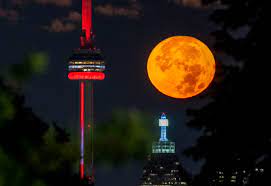
It was a Supermoon, and was full November 5th; fullest at 8:19 a.m.  Chill in the air.

The full moon was bright and high in the city sky as we were coming home that night from Koerner Hall. The evening was filled with acoustic strings and beautiful harmonies. I'm With Her and Ye Vagabonds took the stage.

I think my favourite tune of the night was Ye Vegabonds' 'Blue is the Eye,' 

There is also a Ye Vagabonds song that mentions the moon repeatedly in its lyrics is "When We Were Trees" The lyrics include the lines:"And the moon will wax and wane. It will soon come around again". In this world of Spotify and YouTube, I can find it on neither as of yet, but I can listen in my mind's ear:


When We Were Trees

[Verse 1]
When we were trees in another life
Our roots touching, our branches entwined
We were dancing in the breeze
And the sun shone on our leaves

[Verse 2]
When we had wings tunneling through clouds
Our hearts will full, and our voices were loud
We were balanced on the air
And we sailed without a care

[Verse 3]
The ground was green, and the sun was young
I was the Earth, you were the falling rain
We will soon be passing on
We will soon return again

[Verse 4]
I will be the charge, and you will be the wire
The bold red rose and the shining briar
And the moon will wax and wane
It will soon come around again


Wednesday, December 13, 2023

Music for my Playlists - 2023


King Singers (Koerner, Feb)
TSO Return to Massey Hall (Massey Hall, Feb)
Orchestra Toronto (Meridian, Feb)
Visions of Spain (TSO, Roy Thomson Hall, March)
Red Hot Ramble (Old Mill, March)
John Pizzarelli (Markham Theatre, April)
Frank and Ella (TSO, Roy Thomson, April)
Ukulele Orchestra (Koerner, May)
Macbeth Opera (Four Seasons, May) guests of Sarah and Patrick
Buddy Guy (Chicago, May)
Rite of Spring, Opening night of the 101st season (TSO, Roy Thomson Hall, September)
Coplands Clarinet (TSO, Roy Thomson Hall, October)
Chanticleer (Koerner, October)
Invincible Czars accompany silent movie Dr. Kaligari (Fox theatre, October)
Danish String Quartet (Koerner, November)
Christian McBride (Koerner, November)
Loreena McKinnet (Koerner, December)
Holiday Pops (TSO, Roy Thomson Hall, December)

Finally! The Ukulele Orchestra of Great Britain made it to Toronto.
We had seats booked in 2020 and then Covid hit.


 Getting to your seats can be a challenge but there are great acoustics up in the cheap seats at Massey Hall!

Thursday, August 31, 2023

Super Blue Moon! August 2023

A Blue Moon Super Moon! A stellar occasion! Lots of hype on media. Nice to have something non-controversial and not depressing making a few headlines. 


Evergreen hits and great cover versions to make a playlist

The Moon, the astronomical body that orbits Earth, is one of the most inspirational objects for human creativity. It has inspired words from Shakespeare, Wordsworth, and Joyce, and paintings from Rembrandt, Van Gogh, and Magritte. There have also been songs about the Moon, by artists including The Beatles (“Mr. Moonlight”), The Rolling Stones (“Moon Is Up”) and Pink Floyd (”The Dark Side Of the Moon”).

As well as prompting evergreen hits such as “Fly Me To the Moon,” the Moon has been the subject of comedy songs (Laurel And Hardy’s “Lazy Moon,” The Stargazers’ No.1 60s hit, “I See the Moon”), political songs (Gil Scott-Heron’s “Whitey On The Moon”) and numerous instrumentals (Enya’s “Moon Shepherdess”). The Moon and outer space are often used in ballads to provide the imagery expressing the enormity of emotion. In 1960, Mel Tormé went as far as to record a whole album for Verve based on moon songs, called Swingin’ On The Moon.

Carpenters even recorded a song in 1976, ”Calling Occupants Of Interplanetary Craft”, which aimed to send out a telepathic message to visitors from outer space. The thought of the loneliness of interstellar travel inspired David Bowie to write “Space Oddity” and led to Elton John and Bernie Taupin’s “Rocket Man”.

As the world celebrates the anniversary of the Moon landing of July 20, 1969, we honor those astral explorers with our pick of the 20 best songs about the Moon and space travel. Some of your favorites – such as Simon And Garfunkel’s “Song About The Moon” – may have just missed out, so let us know in the comments if there are any songs that should have been on board.

20: “The Moon Is A Harsh Mistress” (Glen Campbell, 1974)

Jimmy Webb is one of the great modern songwriters and his song “The Moon Is A Harsh Mistress” is a shining example of his lyrical prowess: “Though she looks as warm as gold/The Moon’s a harsh mistress/The Moon can be so cold.” Numerous star performers have covered Webb’s moon song, including Judy Collins, Linda Ronstadt, Joan Baez and Joe Cocker. The definitive version, though, was the one by Glen Campbell for his 1974 album Reunion: The Songs Of Jimmy Webb.

19: “Moon At The Window” (Joni Mitchell, 1983)

Joni Mitchell said that, though some critics dismissed “Moon At The Window’ as “eccentric,” she thought that in the song she had “gone closer to jazz than I have ever gone while working harmonically outside the laws of jazz.” Wayne Shorter plays some intimate soprano saxophone on a track that took its name from the Zen poetry of Ryoken (“The thief left it behind: the moon at my window”). The song appeared on Mitchell”s 1983 album, Wild Things Run Fast.

18: “Once In A Very Blue Moon” (Nanci Griffith, 1984)

Pat Algar is a respected country music songwriter whose compositions have been covered by The Everly Brothers, Garth Brooks and Crystal Gayle. One of his sweetest songs proved a seminal one for Nanci Griffith, when she recorded “Once In A Very Blue Moon,” the title track of her 1984 album. She later named her orchestra after the song. “Once In A Very Blue Moon” has been covered by Mary Black and Dolly Parton.

The Moon is an inspirational object for country musicians, and other leading country songs about the Moon include ones by Hank Williams (“Howlin’ At The Moon”), Lyle Lovett (“Moon On My Shoulder”) Patty Griffin (“Moon Song”) and Dar Williams (“Calling The Moon”).

17: “Drunk On The Moon” (Tom Waits, 1974)

It is no surprise that Tom Waits has come up with original songs about the Moon, including “Grapefruit Moon.” Perhaps his best is “Drunk On The Moon,” which was recorded for the 1974 album The Heart Of Saturday Night. The jazzy, late-night atmosphere of the song complements inventive lyrics (“The Moon’s a silver slipper/It’s pouring champagne stars”) and the track features fine playing from tenor saxophonist Pete Christlieb, who played with Louie Bellson, Chet Baker and Count Basie. “Drunk On The Moon” was inspired by The Terminal bar in Denver, Colorado. “There’s all different kinds of moons – silver slipper moons and there’s cue ball moons and there’s buttery moons and moons that are all melted off to one side, and “Drunk On The Moon” is about a muscatel moon,” said Waits.

16: “Shame On The Moon” (Bob Seger, 1982)

The first version of “Shame On The Moon” was cut by its creator Rodney Crowell (with wife Rosanne Cash singing harmony vocals). The song later became a massive hit for Detroit musician Bob Seger and his Silver Bullet Band. It was used as the single to promote his 1982 album The Distance, and the track features a sparkling piano solo by Little Feat member Bill Payne. “It’s like a cowboy song and the track is flawless, the best and tightest track on the album,” said Seger. “We cut it in like two hours, and everyone decided it was the miracle track. But then we had to decide whether to use it or not because The Distance was going to be a real rock album… the next the next thing we know, the Capitol Records guys are saying, ‘That’s the single!’ I’m beholden to Rodney for writing it.”

15: “An Ending (Ascent)” (Brian Eno, 1983)

Brian Eno’s landmark album Apollo: Atmospheres And Soundtracks is being reissued, with an additional album’s worth of new recordings, to celebrate the 50th anniversary of the Apollo 11 moon landing. The songs from Apollo, originally released in 1983, have featured in films, television shows and commercials. “An Ending (Ascent)” was used in the 2012 London Olympics opening ceremony. Among the new tracks on the 2019 release is a composition by Roger Eno called “Under The Moon.”

14: “Moonlight Serenade” (Glenn Miller, 1939)

Glenn Miller’s famous swing ballad “Moonlight Serenade” turned 80 in April 2019, and the bandleader’s signature tune is one of the most instantly recognisable melodies in popular music. Mitchell Parish subsequently wrote song lyrics – “I stand at your gate/And the song that I sing is of moonlight” – which were recorded by Frank Sinatra for a whole album of moon songs (Moonlight Sinatra, 1965). However, it is the instrumental version of Miller’s classic that endures. Other jazz musicians have been inspired to write and perform songs about the Moon, including Duke Ellington (“Moon Mist”) and Miles Davis (“Moon Dreams”), Louis Armstrong and Oscar Peterson (“Moon Song”), and Stéphane Grappelli and Django Reinhardt (“Moonglow”).

13: “Pink Moon” (Nick Drake, 1972)

Nick Drake played acoustic guitar and the minimalist piano solo on “Pink Moon,” the title track from his 1972 album, but his pretty solo seems out of kilter with the darkness of his lyrics: “Saw it written and I saw it say/Pink moon is on its way/And none of you stand so tall/Pink moon gonna get ye all.” This two-minute gem was written at a time when he was suffering from depression and living in a small flat in London’s Haverstock Hill. The pink – or blood – moon has been referenced as an evil portent since The Book Of Revelation and seemed to be Drake’s prophecy of dark days to come. It also provided inspiration for Sidney Bechet’s passionately expansive solo on “Blood On The Moon,” which was composed in the studio just before recording.

12: “Walking On the Moon” (The Police, 1979)

Sting’s memorable song, which he said came to him as a riff one night when he was drunk in Munich, went straight to No.1 in December 1979. The success of the single was helped by a lively music video that had been filmed a couple of months before, at the Kennedy Space Centre in Florida. The video features The Police miming to the track in among spacecraft displays, interspersed with NASA footage; Stewart Copeland played drumsticks on a Saturn V moon rocket. A new version of “Walking On The Moon” appears on Sting’s My Songs album, which the singer described as “reconstructed” versions of his hits, “with a contemporary focus.”

11: “Man On The Moon” (R.E.M., 1992)

“Man On The Moon,” which appeared on R.E.M.’s eighth album, Automatic For The People, was a massive hit in 1992 and remains one of R.E.M.’s most popular tunes. It is the only entry in this list of songs about the Moon to deal with the conspiracy theories about the 1969 moon landing being faked. Mike Mills, who was credited as a co-writer of “Man On The Moon,” said that they had deliberately written about Andy Kaufman in the song because of odd theories that the comedian had faked his death. “He’s the perfect ghost to lead you through this tour of questioning things,” Mills said in 2018. “Did the Moon landing really happen? Is Elvis really dead? Kaufman was kind of an ephemeral figure at that point, so he was the perfect guy to tie all this stuff together as you journey through childhood and touchstones of life.”

10: “Moondance” (Van Morrison, 1970)

Though Van Morrison’s sparkling lyrics – “Can I just have one more moondance with you, my love” – are catchy, they were in fact written after the Belfast singer had composed the music. “With ‘Moondance,’ I wrote the melody first,” said Van Morrison in 1973. “I played the melody on a soprano sax and knew I had a song, so I wrote lyrics to go with the melody. For me, ‘Moondance’ is a sophisticated song. Frank Sinatra wouldn’t be out of place singing that.” For the recording, incidentally, Morrison handed over saxophone duties to the late Jack Schroer.

9: “Blue Moon Of Kentucky” (Elvis Presley, 1954)

When Bill Monroe recorded a version of his own song “Blue Moon Of Kentucky” in 1946, he cut it as a slow waltz. Eight years later, a young Elvis Presley was larking about in Sun Studios with guitarist Scotty Moore and bass player Bill Black. “We’re taking a little break and Bill starts beating on the bass and singing ‘Blue Moon Of Kentucky,’ mocking Bill Monroe, singing the high falsetto voice. Elvis joins in with him, starts playing and singing along with him,” recalled Moore. Producer Sam Phillips recognised the potential of their interpretation and told them to record it as an upbeat, blues-based tune. “Blue Moon Of Kentucky,” which was released as a 7” single on 19 July 1954 – just 12 days after being recorded – was an instant hit.

8: “Moonshadow” (Cat Stevens, 1970)

Cat Stevens is a master of memorable images, and he said that his favorite of all the songs he has written was “Moonshadow,” which was released as a single in September 1970, ahead of its inclusion on the album Teaser And The Firecat. Stevens grew up in the bustling Holborn area of central London and said that it was an experience on holiday that prompted him to write this song of hope. “In the West End of London there were bright lights, so I never got to see the Moon on its own in the dark, there were always streetlamps,” said the man now known as Yusuf Islam. “So there I was on the edge of the water on a beautiful night with the Moon glowing, and suddenly I looked down and saw my shadow. I thought that was so cool, I’d never seen it before.”

7: “Moon River” (Sarah Vaughan, 1963)

Though Henry Mancini and Johnny Mercer’s delightfully romantic song “Moon River” will forever be associated with Audrey Hepburn’s version in the 1961 movie Breakfast At Tiffany’s, the Oscar- and Grammy-winning song was later covered by some of the greatest singers of modern popular music, including Judy Garland, Aretha Franklin, Rod Stewart and Amy Winehouse. There is a great version by Sarah Vaughan on the 1963 Verve Records album Sarah Vaughan Sings The Mancini Songbook. If you want a moving version by a male singer, then check out Louis Armstrong’s interpretation, late in his life, on the album Hello, Dolly! His trumpet solo is sweet – as is the instrumental jazz version by Dizzy Gillespie. The song’s enduring appeal was demonstrated in 2018 with a fine version by Frank Ocean.

6: “How High The Moon” (Les Paul And Mary Ford, 1951)

The jazz standard “How High The Moon” was written by Morgan Lewis and lyricist Nancy Hamilton for the 1940 Broadway drama Two For The Show. Benny Goodman recorded the first instrumental version, but the classic version was by Les Paul and Mary Ford for Capitol Records in January 1951. The husband-and-wife recording spent nine weeks at No.1 on the Billboard chart and showcases the intricate, vibrant style of playing that made Paul such an influential guitarist. There have been hundreds of cover versions, in a range of genres and styles, including versions by Chet Baker (jazz), Marvin Gaye (soul), Gloria Gaynor (disco) and Emmylou Harris (country).

5: “Bad Moon Rising” (Creedence Clearwater Revival, 1969)

As well as being a symbol of romance and mystery, the Moon can also be a portent of doom. When author Christopher Isherwood was making a living as scriptwriter at MGM in Hollywood in the 30s, he wrote a line into the 1941 Ingrid Bergman thriller Rage In Heaven about the bad vibes from the astronomical body: “The Moon. It’s staring at me, like a great eye.” Another bleak Hollywood movie, The Devil And Daniel Webster, inspired John Fogerty to compose “Bad Moon Rising,” which features lyrics about the “the apocalypse that was going to be visited upon us.” “Bad Moon Rising” is well suited to the soundtrack of the comedy-horror An American Werewolf In London (1981) and the song has been covered by Jerry Lee Lewis and Emmylou Harris.

4: “Blue Moon” (Billie Holiday, 1952)

“Blue Moon” evolved as a song from the MGM soundtrack-writing system, with Richard Rodgers and Lorenz Hart penning the final version for a Clark Gable film called Manhattan Melodrama. The beautiful lyrics – “Blue moon/You saw me standing alone/Without a dream in my heart/Without a love of my own” – are tailor-made for any skilled vocalist to interpret. One of the finest versions was by Billie Holiday for Verve (with backing from jazz greats such as Barney Kessel on guitar, Ray Brown on bass and Oscar Peterson on piano). It is such a magnificent song that you could take your pick of versions by other artists, including Elvis Presley, Mel Tormé, Ella Fitzgerald and Dean Martin. The excellent Beck song about loneliness, “Blue Moon,” tips a nod to Rodgers and Hart by using the same song title.

3: “Fly Me To The Moon” (Frank Sinatra, 1964)

When songwriter Bart Howard first came up with the lyrics for his magnificent standard “Fly Me To The Moon” he originally titled the song “In Other Words.” There have been so many brilliant versions of “Fly Me To The Moon” that it would be impossible to pick the very finest, but among the best interpretations are those by Doris Day, Anita O’Day, Astrud Gilberto, Nat “King” Cole and Julie London. The most famous, however, is Frank Sinatra’s 1964 recording. Sinatra’s version was played on the Apollo 10 mission which orbited the Moon in May 1969. The song was also rumored to have been the first music ever heard on the Moon itself, when it was reportedly played on a portable cassette player by Apollo 11 astronaut Buzz Aldrin, after he stepped on the Moon’s surface. Aldrin later said he could not remember for sure, however.

2: “Rocket Man (I Think It’s Going To Be A Long, Long Time)” (Elton John, 1972)

Elton John said he was “blown away” by David Bowie’s “Space Oddity” and credited it as a major inspiration. So when Bernie Taupin came up with his own interstellar travel song – partly inspired by a short story in Ray Bradbury’s book The Illustrated Man – John leapt at the chance to record “Rocket Man (I Think It’s Going To Be A Long, Long Time).” John even used Bowie’s producer – former Decca Records man Gus Dudgeon – to be the controller on the ground for his inclusion in this list of songs about the Moon. In 2016, following Bowie’s death, John played an instrumental version of “Space Oddity,” which he then segued into his own hit “Rocket Man.” John’s song, which has been downloaded nearly half a million times, provided the title for the hit 2019 biopic about the singer’s life.

1: “Space Oddity” (David Bowie, 1969)

“Space Oddity” was rushed out as a single on July 11, 1969, five days before the Apollo 11 launch, and nine days before Neil Armstrong became the first man on the Moon. David Bowie’s main inspiration was the film 2001: A Space Odyssey, and his song is full of eerie, melancholy lyrics about a Major Tom who is stranded in space: “Here am I floating round my tin can/Far above the Moon/Planet Earth is blue/And there’s nothing I can do.”

The song was actually played by the BBC during its coverage of the Apollo launch. “I’m sure the BBC really weren’t listening to the lyric at all,” said Bowie. “It wasn’t a pleasant thing to juxtapose against a moon landing. Of course, I was overjoyed that they did.” Bowie would later revisit his Major Tom character in “Ashes To Ashes” and “Hallo Spaceboy.”

Sunday, December 11, 2022

Out and About


I Love Toronto! 

Such a vibrant city for theatre, live music, author talks. This November/December I seem to be greedy. Well, maybe just hungry after the long lapse of Covid isolation. It's good to be out and about, and most of these events have been almost full capacity, which is much needed for the concert halls and theatres.

I'm still wearing a mask to these events, probably about 1/3 of the audience are joining me.  

December
  • Red Velvet, Crows Nest Theatre / December 10
  • Kronos Quartet, Koerner Hall / December 8
  • Wintersong, Laila Biali & Jane Bunnett & Emilie-Claire Barlow, Koerner Hall / Dec 3
  • Mushrooming, TBG Author Talk / Dec 1
November
  • Soweto Gospel Choir, Koerner Hall / Nov 26
  • Little Dickens, Ronnie Burkett Theatre of Marionettes /Nov 24
  • Toronto Symphony Orchestra ("Pathetique" - Pyotr Ilyich Tchaikovsky; visiting conductor Dalia Stasevska) / Nov 23
  • Heliconian Author Talk: Fayne/Anne Marie MacDonald /Nov 22
  • Second City Comedy Improv, Danforth Hall / Nov 17
  • Choir Boy, Bluma Apel Theatre /Nov 10
  • Ravine Recreate, TBG /Nov 9
  • Meow Meow, Koerner Hall /Nov 4


Thursday, January 28, 2021

Full Wolf Moon


Dazzling rise, early on a winter evening. 

Just 5:30 pm and the moon looking huge and silver.

No wolves in the neighbourhood, but coyotes in the ravine.

Here's some harmony to contemplate on a cold night,  haunting howls and snouts raised to call into the sky.

Other Moanin' in the Moonlight, some Smokestack Lightning from another Howling Wolf.

Thursday, June 4, 2020

Virtual Uke Jam


We've been enjoying Scarborough Uke Jam virtually for the last few months, alternating between Facebook watch parties and Google Meet-ups to play charts. Like many virtual substitutes, it's not quite the same thing but helps us keep connected, and I at least pick up my ukulele once every two weeks.

Most recently, Paul B invited us to collaborate through Soundtrap. Everyone who is participating lays their own track(s) individually and at their own time. It was easy enough to figure out although a bit intimidating at first. Bonus - if you don't like the way it sounds or make a mistake, you just delete the track and start over. A nice little adrenaline rush to hear it all come together at the watch party!

We started with the simple Three Little Birds, and next up, Twist and Shout/La Bamba.

Perfect lyrics for these lockdown times:

Three Little Birds
Don't worry about a thing
'Cause every little thing gonna be alright
Singing' don't worry about a thing
'Cause every little thing gonna be alright
Rise up this mornin'
Smiled with the risin' sun
Three little birds
Perch by my doorstep
Singin' sweet songs
Of melodies pure and true
Saying', (this is my message to you)
Singing' don't worry 'bout a thing
'Cause every little thing gonna be alright
Singing' don't worry (don't worry) 'bout a thing
'Cause every little thing gonna be alright
Rise up this mornin'
Smiled with the risin' sun
Three little birds
Pitch by my doorstep
Singin' sweet songs
Of melodies pure and true
Sayin', this is my message to you
Singin' don't worry about a thing, worry about a thing, oh
Every little thing gonna be alright, don't worry
Singin'

Saturday, March 7, 2020

Performing Arts

Bradford Marsalis Quartet (March)

The quartet has the ease and mastery of impresarios who've been playing together 30+ years. We heard a wide-ranging repertoire from a set list that included bebop, original compositions, jazz standards and popular tunes: Dance of the Evil Toys / Conversation Among the Ruins / Snake Hip Waltz / When I Take My Sugar to Tea / Life Filtering From the Water Flowers / Sunny Side of the Street / The Windup Encore: My Favourite Things

Wintergarten Orchestra (February)

BPYC held a Roaring Twenties party with the Wintergarten Orchestra, featuring music from the 1920s-1930s popular, jazz and cabaret music from America and Europe. We had seats right by the band, and I kept taking photos of the lead singer as there was a bright light at his head and I tried to turn it into a halo and then a ball of fire coming from his mouth.


Tom Allan and Orchestra Toronto (February)

Telling A Tale, including music from Dvorak, Prokofiev, and Raum, with insights from Tom Allan.

From the program notes: Antonin Dvořák's Noonday Witch paints a musical picture of a scary figure from a story told to keep in his native Bohemia to scare children away from playing in the fields under the hot sun. * Toronto composer Elizabeth Raum has set the 14th-century poem Sir Gawain and the Green Knight as a five-movement orchestra suite. The original Middle English saga features one of King Arthur's best known knights. * We all know the story behind Prokoviev's ballet Romeo and Juliet ballet. Prokoviev's own story is less well known. Romeo and Juliet is one of two non-political works that Sergei Prokoviev wrote after his return to the Soviet Union. Among its other quirks, it is one of the rare orchestral works that calls for a tenor saxophone. 

Watching Grace play first violin and bumping into Bluffers at the concert.

Lisa Fischer and Grand Baton, Koerner (January)

What a voice! Fischer has amazing octave range, but also the ability to swell from a soft whisper to commanding volume; and to sustain notes for what seemed like minutes on end. She also worked two different mics - one in her hand that she moved towards and away from her mouth - the other the mic on the stand - creating amazing textures.

She was interpreting classic rock, with selections from Led Zeppelin, Nine Inch Nails, and the Rolling Stones, all bands that she has provided vocals as a back-up singer. An impressive talent in her own right, Fisher was one of the personalities featured in the documentary film 20 Feet from Stardom.

This was part of the Koerner series, Quiet Please There's a Lady on Stage.

Zane Dalal conducts the Royal Conservatory Orchestra with Zakir Hussain, John Patitucci, Danila Perez and Brian Blade, Koerner  January

Zakir is a world renowned tabla virtuoso, coming to the 21C festival for the Canadian premier of Peshkar, a concerto for tabla and orchestra. A beautiful piece!

He also improvised with a trio: John Patitucci (bass); Danilo Perez (piano); Brian Blade (drums). Watching and listening to these maestros play was a pleasure.

This was also the premier for Patitucci's piece Hypoocrisy, an interesting work featuring improvisations between the jazz trio and orchestra.

Sweat, CanStage,  January


Lynn Nottage won the Pulitzer for her work on this as playwright.

The performances were a bit uneven, and I wasn't sure whether that was the direction or the actors. Overall, very much worth seeing, as it explores important themes of factory closures, the disappearance of well-paying jobs, and the effects on workers and communities.
Laurie Anderson, Koerner,  January

In the Art of Falling, Anderson fulfilled her ambition to "make a piece that is one long sentence."

She told hypnotic stories, performed tai chi, and played viola accompanied by cellist Rubin Kodhelo. During the night she retold pieces of Aristophanes' comedy, The Birds, but left out the ending, to entice the audience into reading the play. Anderson spoke about her late husband, Lou Reid, and the tai chi sequence was in honour of his love of martial arts; so very moving to watch.

Caesar, Streetcar Crowsnest,  January
Shakespeare's play was interpreted by the Groundling theatre company.

True to his text, except for the beginning and end. The beginning helped set context by taking the form of political commentators delivering opinions of unfolding events in ancient Rome; the end brought the characters back from the dead to comment on their motivations. I thought the beginning very effective. I thought the end provided useful insights but was somewhat condescending; maybe it would have been better to bring the political commentators back to bookend the play with the same conceit.

Monday, December 16, 2019

We wish you a Merry Christmas!

Joy, awe, wonder... conjured by music.

Such a powerful medium for time travel to Christmas' past, present and future.

This year the holiday season started for me at the end of November, with the Blind Boys of Alabama Christmas show and octogenarians rocking Koerner Hall with gospel classics like Go Tell it on the Mountain.

Choral music the following day filled a tiny church in Caledon with the glorious sounds of the season.  Rob's sister is in the choir and they performed classics such as the Gloria, Christmas Day by Gustav Holst, and Celebration of Light (a Hanukkah original). The Bells of Westminster, a community handbell choir, rang their Christmas bells and chimes. The audience was invited to sing along at parts, lifting spirits even higher.

Would it be Christmas without the carols? Sing-alongs truly put me in the holiday spirit, and it was fun playing ukulele and singing along at the BPYC Christmas party and the Scarborough Uke Jam.

Blind Boys of Alabama Christmas Show, November 29
Achill Choral Society, Glorious Sounds, November 30
Carols and Lost at C, BPYC Christmas Party, December 14
Holiday Sing-along, Scarborough Uke Jam, December 15