Showing posts with label Paris London. Show all posts

Sunday, April 19, 2015

Thinking of Paris in the Spring

Thinking about Paris in the spring. The French Foodie Fete stirred memories.  And Lois is there now, posting photos of her view of the Louvre. Lucky Kaarina is heading there in May.

Oh, to be in Paris in the springtime!  I would want to revisit the green spaces to breathe in the fresh air.  Relax in the grotto at the Luxenbourg Gardens. Picnic in Versailles, and hang out at Marie Antoinette's Petit Trianon. Contemplate in the gardens at Notre Dame, stroll through the sculpture garden at the Rodin Museum. The Sunday flower market on Île de la Cité would be spectacular!  I never did make it out to Giverny, that must be lovely if you can time it right to avoid the crowds.

Petit Trianon - rent a golf cart or bike to cover more territory
Or maybe just a reverie in L'Orangerie Les Nympheas, to enjoy Monet's canvas gardens. What a wonderful space. The gallery incorporates natural light, and if you sit long enough you can see the colours change as clouds pass overhead.
I would visit Sainte-Chapelle on a sunny day, to watch the stained glass colours dance on  granite walls.

City of Light.

Go to gaze at Chagall's ceiling at the Opera Garnier, and afterward grab lunch at one of the great restaurants nearby where the Parisians eat.

Food ! A breakfast of crepes with strong cider. A visit to Rue Mouffetard, to see if the rotisserie chicken was really as good as I remember.  Pick up the ingredients to cook a simple meal at the Bastille Market, or anywhere that sells local produce, because the vegetables last fall were bursting with flavour. Maybe there is some rhubarb and dandelion greens in the stalls, just add fresh cheese for a tasty spring salad, grill the catch of the day, and serve with fresh baguette for a light dinner.

A day pass on the batobus, hopping on & off to visit the galleries and then staying for the light show at night. What a view of the city, the bridges, Notre Dame, the Eiffel. Revelrie along the Seine, with couples dancing at the Jardin des Plantes, and street entertainment on the bridges. Bring your own wine, claim a space on a bench or sidewalk, and enjoy the show!

Wednesday, February 4, 2015

Visiting Paris and London for the first time?


For Lois, who just booked her first trip to Paris & London...

Of course you are doing your research beforehand on Google Earth, You Tube, Trip Advisor, Rick Steeves...  I also read lots of fiction and nonfiction (history, art, architecture) and watched movies (Midnight in Paris!).  This helped tailor the list of the things we wanted to do and places to see on our all-too-brief tour. Definitely part of the pleasure is planning! I also asked friends who had visited for their thoughts.

One friend who earned a living for many years as a newspaper reporter was often called on to write travel pieces. He would spend the first day or two touring by land and then by water to get an overall sense of the geographical orientation.  Of course, Ciairan had an expense account and hotels eager to impress, so there were often limo drivers involved. For Rob and I, visiting Paris and London for the first time, the 'hop on hop off' tours were a great option, and the providers we chose offered both land and waterway tours. Along the way we were able to pick up the sense of place in neighbourhoods and districts, directly experience which hold the most appeal personally, and then go back to spend more time. Although we certainly did a lot of research beforehand, taking the 'overview tour' really did confirm where we wanted to spend our moments.  Even the best primary sources can't capture the vibes, kinetic energy, sounds and smells that resonate with your unique tastes. Also great was getting a birds-eye-view: if you time it right, you can begin your visit on the London Eye or Eiffel Tower in the daylight, enjoy sunset and then gaze upon the night lights.

Once we had a real sense of where we wanted to spend our precious time and energy, we'd visit the neighbourhood and target the things & places we wanted to see within it. The research we'd done beforehand would help us know which days were best for what activities (i.e. Louvre is closed on Tuesdays, or the dates and times for the changing of the Guards).

My favourite sections in travel books were the 'Guided Walks' that mapped out foot-friendly routes. Many of the places you walk past have interesting histories, so it is worthwhile to learn something about the back-story on who lived at the address. London generally puts plaques on their buildings, but Paris is very understated that way... I would never have known I was a block away from where Baudelaire held his opium soirees if I hadn't picked up a Frommer's.  Once I knew the address I had to go just to stand on the street in front of the building, imagining the comings and goings over the centuries.

Alex recommended guided walks, and our friend Laura spoke highly of London Walks, which led us to check out Paris Walks. There is lots to choose from, just pick a day and topic of interest and show up, no need to book ahead. The guides were incredibly informed and entertaining, and we learned something new every time. Definitely time well spent!

There were some places that were obligatory to visit as 'first-timers'.  How could we not spend time at the Louvre, or go up the iconic Eiffel? The Changing of the Guards was originally on our London itinerary, and we actually made it to the gates but ended up blowing it off because we'd have to wait more than an hour to hold our position for a decent view. Some things are best seen on You Tube. We also tried to mix things up a bit and get to places a bit less trod by tourists, like the Canal St. Martin and a narrow boat tour that started in Little Venice.

Our itineraries were definitely packed but we did try to leave some room for serendipity...  easier said than done because there was so much we wanted to see, but really, some of the best memories were just sitting in cafes or galleries and watching the world go by.  

Eating and drinking? I had a list of places I wanted to eat and drink in each city but other destinations ended up taking priority once we arrived. We'd generally have one 'nice' meal a day, either lunch or dinner, having a fortifying breakfast at home before heading out on our whirlwind tours.  After several hours of running around, we'd realize we were extremely hungry, and that realization would hit us when we were right in the midst of a major tourist district. This did not lead to the best culinary experiences. A general rule of thumb would be to avoid the touristy restaurants where they overcharge for mediocre fare and try to enjoy meals where you see the Londoners and Parisians dining. And if you want to go to a really special place, like the Jules Verne in the Eiffel Tower, you need to book weeks if not months in advance. Bring water bottles you can fill up from home and at stops along the way, and put some nutritious snacks in your pocket so you won't be tempted to fuel-up at tourist traps. In Paris, we had a couple memorable picnics seated by the Seine, complete with a bottle of wine and often live musicians. The batobus goes up and down the river all night, with Paris all lit up and sparkly, and we didn't have any trouble bringing light refreshments along for the ride. In London, the Markets (Borough and Camden) offered the most incredibly tasty and delicious tasting menus!

For more of my thoughts on Paris and London, click here.

Wednesday, October 1, 2014

Edward Rutherfurd's Paris


How could the cover not catch my eye? But when I opened the book at random and read a few paragraphs, I thought I'd pass. It looked a bit too much of a romantic saga, and at 809 pages, it was several inches thick.

A few weeks later I changed my mind and purchased an e-book to read on the trip to Paris. I'm glad I did! While it is a bit formulaic, it is a great formula with strong execution. Epic! The novel follows six different family lines through eight hundred years.

I found the book entertaining, informative, and thoroughly enjoyable.

Incredibly well researched! It includes gossipy accounts about Louis the XIV's suspect parentage;  informed opinions on whether Hemingway was exaggerating the extent of his poverty as a young novelist; horrific details about the slaughter of Protestants in the St. Bartholomew's Day massacre; the role of women over the centuries. Toronto and Canada both get mentioned, which I always appreciate.

Literary reviews of Rutherfurd's Paris are typically unkind, but I think they somewhat miss the point. They're so bitchy they're almost funny:
  • The Telegraph Review: This is history for people who can’t be bothered to read it, an 800-page whizz through eight centuries of Parisian life in which every character has swallowed a guidebook and no one is ever short of a round-eyed audience to bombard with the fact-cannon." 
  •  The Washington Post: He isn’t a novelist; he’s a docent, shoehorning facts into every scene and conversation. A passing painter describes what realism is. Monsieur Gustave Eiffel lectures young Thomas Gascon on the structural engineering of his new tower. The artist Marc Blanchard describes the history of Paris to an American friend: “So we have, for instance, the ancient Ile de la Cite, and the Montagne Sainte-Genevieve where the university is, which was once a Roman forum.” The characters may be French, but their native tongue is Wikipedia.
  • The Toronto Star: ...these books aren’t really stories. Rather they are histories with a spoonful of sugar provided by the narrative. Paris moves back and forth in time between several major periods and weaves together the lives of various family lines from generation to generation. But Rutherfurd’s characters are not really independent people: they serve only to be convenient witnesses for historical events, and as such their motivations are usually completely unoriginal and often completely clichéd.
You might not get to know the characters in much depth, but the moments of their lives you do share are distillations of the era. Besides, this is not any one character's story, it is first and foremost a story about Paris. And if you are in love with Paris you will likely love the book. Details about the cathedrals, the views, the streets, the art...

Now, onto London, a 2,000 year old tale touching on Roman times, the Tower, the Globe and St. Paul's.


Monday, September 29, 2014

Rodin

We were touring the Palais Garnier when our guide remarked how fortunate we all were that Rodin had been rejected - twice - by the Ecole des Beaux-Arts. That rejection meant he wouldn't be trained to turn out pieces in the Neo-Classical style that adorn the interior of the Palais. Instead, he would go on to create his own distinctive form and make way for modern sculptors. I'd never really placed Rodin on a timeline before, and was surprised his ground-breaking works were produced as recently as 1860-1911.

Just a few days later, at the Musee D'Orsay, I was standing at the  Gates of Hell plaster, which we would see in bronze at the Musee Rodin a few hours later. It wasn't really planned, but what a great sequence of viewing! And another eye-opener. There was the familiar Thinker, positioned on the Gate, that I have admired for so many years at our own AGO. I had not realized the Thinker was part of a larger composition.

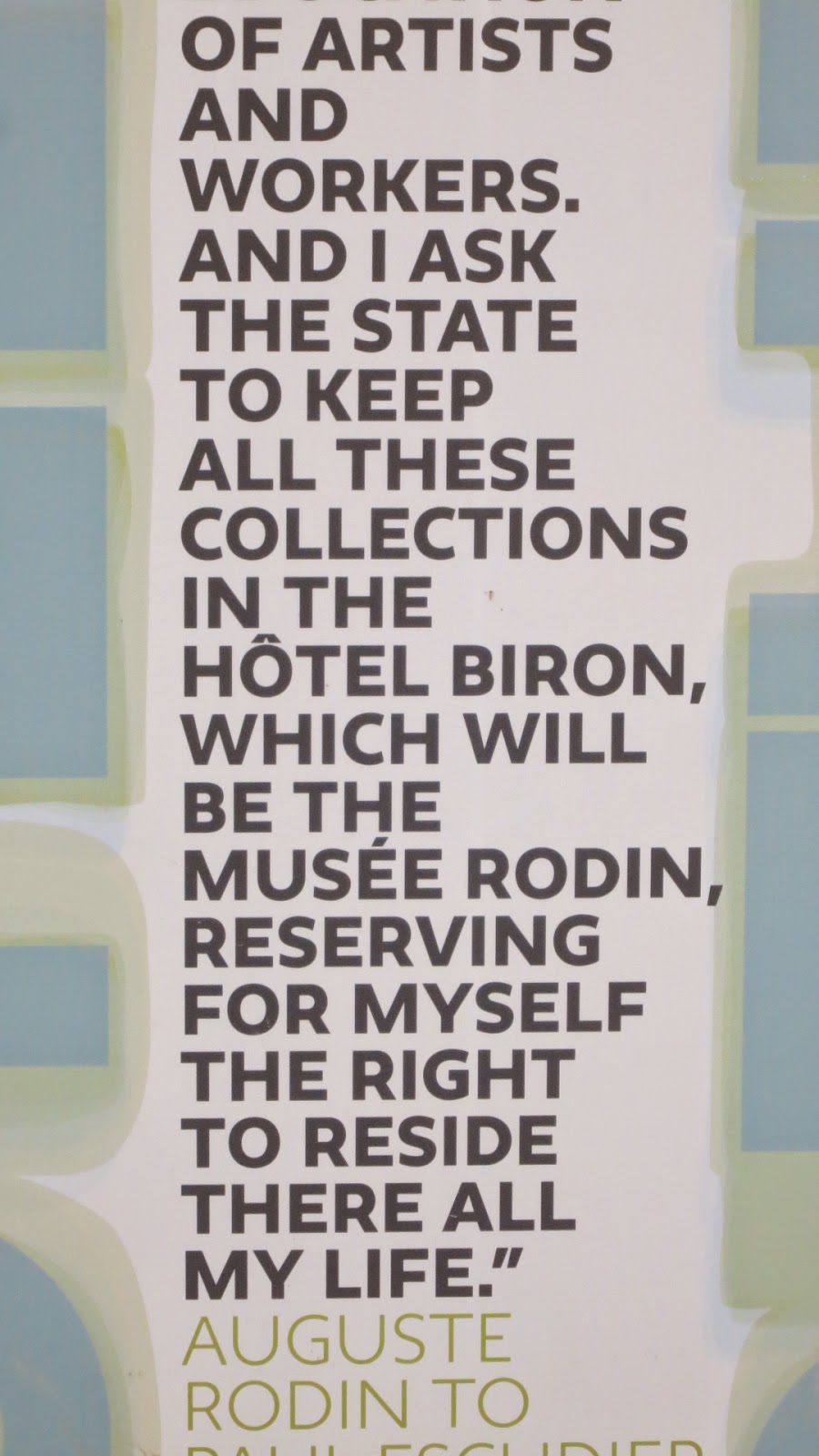
At the Musee Rodin, we wandered the large garden to enjoy the sculptures in the green setting. Rodin himself arranged that Hotel Biron permanently exhibit his sculptures for posterity. In addition to the expansive gardens, there was a gallery devoted solely to marble works, and another large building full of sculpture on display. While we were there,  a retrospective explored connections between Mapplethorpe and Rodin.

By reading the fine print along the way, I was intrigued by connections I hadn't made before. Rainer Maria Rilke, the great poet, was a friend and private secretary to Rodin. There was also the love triangle between Rodin/Claudel/Beuret, which would make a fascinating short fiction. Claudel was a gifted sculptor in her own right, and both modeled for and apprenticed under Rodin before they became lovers. Rodin refused to give up Beuret, the mother of his son. Some believe this may have been part of the reason Claudel went mad and was institutionalized after their affair. Heartbreaking.

Just a week later, we would see Rodin's Burghers of Calais on the grounds of the Palace of Westminster in London. I wandered over to take a long look, admiring the expressions and the upturned hand on one of the figures.

I had not realized at the time, but many believe Claudel to be the artist who sculpted the hands and feet of the Burghers. Also, not realizing it at the time, our Paris apartment was literally steps away from where Camille Claudel lived and worked, on Isle St-Louis. Now I have to go back for a return visit!


Sunday, September 21, 2014

Home Again


A very busy two weeks in Paris and London, literally walking miles every day. We didn't plan our itinerary too much in advance, but we did have a list of things we wanted to see. Having limited time and a lengthy list made for some exhausting days. No time for souvenir shopping in either place, although I did come back with thousands of digital images, wonderful experiences, and lots to think about.

It would have been ideal to be able to visit these cities just before heading off to university, to give context to studies of history, art and music. Being there made the subjects more of an experience, versus something read about on a flat, printed page. I could imagine what it would have been like for people attending mass in Notre Dame through the centuries, or what it might have been like to mudlark on the side of the Thames for treasure when the tides went out.
 
Both cities are so rich with history everywhere you look. In London, just having a drink at the local pub could be mind boggling. And history layered on history.... Plaques on doors and alleyways noting Lawrence of Arabia lived here, or the Rose Theatre was erected here in 1587, or the Clink was first built on this corner in 1104. In Paris, we stayed at St-Louis-en-I'lle, just across the street from the church built in 1624 and around the corner from our apartment, was 17 quai d'Anjou, where Baudelaire used to host his hash parties. (I tried to snap some photos but the guard at what is now the Paris Institute stopped me from entering the courtyard).

Churches and palaces modified through centuries to accommodate new faiths, evolving tastes and new knowledge. Museums like the Louvre or the Victoria and Albert that seem to stretch on for miles. Cathedrals built on the sites of Roman temples built over tribal lands.

Some of the trip highlights were spent wandering through the parks. Beautiful green and blue spaces to rest and recover. Public transportation integrated into waterways, and riverbanks along the Seine and the Thames both claiming public lands along their edge. Gardens and parks on arteries further afield. Paris has about 10% dedicated to public green space, such as Luxenbourg or Jardin des Plantes. London has 35,000 acres, or almost 40% of its surface area, dedicated to green space; there must be incredible pressure to yield  to new development. With the densities of these cities the parks are essential. I hope London manages to preserve their gardens and parks. 

Incredible wealth on these streets, especially London, where houses in downtown Belgravia sell for 80 million pounds and Maserati are parked out front on the curb. The average house price hit $500,000 pounds during our stay, with headlines crying out against the extra stamp tax and high salaries needed to even get a toe on the property ladder. There was definitely more hustle and traffic in London. Rush hour was flooded with moms taking their uniformed kids off to school, road warriors on bikes, men and women in suits. Roads flooded with cars, doubledecker buses stalled, people doing business on their cell phones.

In contrast, Paris was much more laid back. The business people seemed to have time to take lunches in cafes, and the pace of walkers on the streets was much less frantic. We met several visitors who travel there on at least an annual basis, some mentioning more than 20 visits. Staying that frequently, you might as well invest in some real estate. Prices there have been falling in recent months but with costs per square meter ranging upwards from EUR 8,500, it still makes Toronto look affordable.

Speaking of Toronto... it is great to be home. Our 'city within a park', our comfortable bed, our garden. Feeling more connected now to these two cities across the Atlantic and to the history of European nations. Why does it make me somehow happier to know I am just a little speck in time, in this great big sea of life?

The wonder of it all.


Friday, September 19, 2014

London Calling

Day One: Looked out the window of our Paris apartment one last time, then it was off to the EuroTrain/chunnel and London. What a great way to travel! Checked into our flat across from Battersea Park, and visited the Masons Arms gastro pub just around the corner. Back to the flat to unpack and settle in.  Day Two: Hop on/hop off to take in the London sites... Big Ben, Bloomsbury, Green Park, Hyde Park, Harrod's, The London Eye, the Thames. Hopped off at Buckingham Palace for the changing of the Guards, walked the gardens and saw a pelican. Visited St. Paul's Cathedral just as a choir was singing Mozart's Holy Eucharist. Walked around Picadilly Circus (well-named, indeed!). Day Three: Cruise down the Thames to Greenwich. Maritime Museum, Royal Observatory, Greenwich Park. I love the carved figureheads and ships' badges. English fish and chips for lunch. In the evening, a birds' eye view at sunset of all the sites we've been taking in on the London Eye... Day Four: Trip to Little Venice, and then a canal boat tour through Regent Park and down to Camden Locke. On to Westminster, for a London Walk in the 1,000 year old city, looking at the Palace and the Abbey. Stuck around for Evensong and its beautiful choir. Then off to Albert's for a cider before heading home to Battersea and dinner at home.  Day Five: Out to the Cotswolds (Minster Lovell and Burford) for a taste of the English countryside and medieval villages.  Then touring around the quads of Oxford colleges & the Bodliean Library (which houses all books published in Britain) & Sheldonian Theatre (designed by Christopher Wren). My neck is sore from walking around for hours looking up and up. Dinner at the Naz to satisfy a craving for Tikka masala.  Day Six: The Tower of London tour with a Beef Eater, and then time to wander around and look at the Crown Jewels, the Armoury, the Dungeon. We spoke at length with the Beef Eater in charge of looking after the Tower's Ravens. Then it was off to the Borough Market to sample some great food (especially loved Neal's Yard and sampling English cheeses!). A walk past  The Globe Theatre. Mudlarking Bankside in Southwark while the tide was out, and then a very quick run into the Tate Modern before it closed to look at a Surrealist exhibition. Dinner at the Boqueria for Spanish tapas. Day Seven: Basically walked the entire day. Through Battersea Park, The British National Museum and the Victoria and Albert. If I was wearing a pedometer I think it would read 40+ km for the day. Such great sights, too. The Peace Pagoda in Battersea; the Rosetta Stone, Easter Island statue and Elgin Marbles from the Parthenon at the British Museum; entire tombs and colossal marble arches at the V&A. The scale of the exhibits in these museums is massive, so the buildings need to be huge to accommodate them. Day Eight: Packed up our bags in the a.m., stored our bags in 'left luggage' at Paddington Station so we could walk through Kensington Gardens and Hyde Park, ate lunch at Harrods, nipped in to the V&A for another look, then the Heathrow Express for the flight home.
... details to follow...

London Birds

One of travel's pleasures is coming upon the unexpected, and in London I was surprised by the birds. In Paris, there were pigeons everywhere but the bird market, so I expected the same in London.

The first day, near our flat in Battersea Park, there were bright green parrots squabbling in the trees. We saw them again the next day, at Buckingham Palace St. James Park, along with mute swans, moorhens and coots. Most surprisingly, a pelican! Beautifully coloured common magpies were hopping around almost everywhere.

Then at the Tower of London, the Ravens. Their wings are clipped due to the superstition that the Tower will fall  if there are not six ravens on hand to guard it at all times. Now there are eight, just in case. Huge, black, barking and ominous.

The birds may be captives, but they are well tended and fed meat with bloody cookies regularly. There is even a Yeoman Warder Beefeater tasked with the responsibility to look after them.

To even qualify for the position of Beefeater, you must have served 22 years in the military as a senior or petty officers and hold the Longservice and Good Conduct award. There have only been 400 Beefeaters to date, so it is quite a distinction to join the corps.

We chatted at length to the Yeoman in charge of these creatures. He actually had an arm patch of a Raven on the sleeve of his uniform.  Shortly after joining the elite security team. their current keeper noticed the birds had taken a liking to the newcomer, so 'took him under his wing' and trained him. Initiation included spending time in the cage, birds pecking. Duties of the Raven Guard  include feeding, clipping, monitoring the Ravens overall health, investigating their deaths, introducing new birds, protecting the existing flock, and occasionally recapturing and returning birds to Tower grounds. Just the week before, a pair had hopped over the wall and the Beefeater searched for five days to bring them back (wearing plainclothes). He knows each of the birds by their size, shape, call, and personality, and spoke about their moods with affection.

A few years ago, a fox managed to get on the grounds and kill two birds, causing security to be 'beefed up'. The average raven life span is about twenty years, while the current age of the oldest Tower Raven is forty-seven. They seem to have great disdain for the tourists.

Part of me can't help but wonder if the Tower Ravens were jailors or guards in their past lives.


Thursday, September 18, 2014

Sacred Music


Notre Dame
A bit of research prior to our travels showed there was a Sunday Gregorian Mass in Notre Dame, and I wanted to attend. I had envisioned monks in heavy robes and deep voices, but the nuns were doing the chants, voices ascending. To spend an hour just sitting and absorbing this amazing cathedral was a privilege. Centuries of worship must concentrate energy, which may be partly what draws these daily crowds. Hearing the music, looking at the soaring buttresses, admiring  the stained glass, and just simply being in the space was exquisite.

Sacre Couer
Then by design or chance, when we were visiting Sacre Couer I took a seat in a front pew to admire the altar and art of the Basilica. Within a few minutes, a sung Eucharist was beginning. It was just serendipity, and not planned. Nuns again, beautiful voices. Everything was in French so I didn't understand the content word for word, but this was a Catholic mass, so although it has been many years, I certainly had a sense of what they were celebrating. As I sat I had time to take in the gold and stained glass, and to wonder how mosaics of Stars of David had come to the walls gracing the pulpit.

St Paul's Cathedral
Again - at St. Paul's in London, we wandered in during the last half of a sung Eucharist. This time, a Mozart Opus with a men's choir singing verses in Latin. I found myself at the back, looking at the silhouette of the congregation with my gaze drawn up to vaulted ceilings. This time the sombre tones were reminding me of the (mostly) men buried here, including Christopher Wren, the architect who rebuilt the cathedral after the Great Fire of London in 1666.

Westminster Cathedral
Again again.... at the end of the Westminster tour we heard that Evensong would be in just a half hour if we wanted to stay. We did. This time there were no tourists milling about the periphery, and the service took place in a smaller setting. The men's choir sung in Latin, and the priest welcomed His Excellency from Malta who was seated with other guests of honour. On the way out of this structure we walked over the spot where Darwin was entombed, and past the tribute to Sir Isaac Newton. The Tomb of the Unknown Soldier lay at the entrance in a place of honour.

Being in these sacred places and listening to the sacred music made me think of the millions who sat in these place before me, royal and common, devout or politically motivated, with self-interest or the good of the world at the heart of their intention. I also wondered at and about the churches themselves, the sculpture, stained glass, paintings and architecture. So much beauty.

We visited other churches on our travels in Paris and London: Sainte Chappel, St. Louis I'lles, St Etiene, St. John the Baptist in Berford, Saxon Saint Kenselm in Lovell, chapels in Oxford. Are there modern day equivalents? I can think of none. Our common spaces are less divine and not built to last centuries: coliseums, shopping centres, subway cars, parks. Less permanent and ambitious. Less divine.

Today people with great wealth to bequeath tend to sponsor universities and hospitals to be remembered, and churches are careful not to flaunt their riches with so many who need help in their daily lives. A recent exception is the Aga Khan Centre in Toronto that opens gardens and a museum to the public September 18... today, in fact.

Friday, September 12, 2014

Paris log


I have seen glimpses these last eight days of a Monumental Paris, a Sacred Paris, an Historic Paris, a Literary Paris, an Art Paris, Gardens of Paris, Foodie Paris... An exhausting eight days! So tired at night, but I still can't sleep because I don't want to miss anything. Too busy to shop for souvenirs. 

Tomorrow morning, up early to pack and off to London.

Day One: Arrived at our place on I'Ille St-Louis and had a short nap before walking over to the hop on, hop off L'Open Bus Tour. The bus and boat routes were a great way to get our bearings and see all the monuments. Every turn something new and amazing. Spectacular! Such splendour! The Eiffel Tower surprised me. After seeing so many photographs I didn't think I would be so impressed, but this icon has such impact when you see it in person. Day Two: More hop on, hop off. Montmarte, Left Bank, Marais, St. Germaine. Montparnasse. Opera. We got a little off the tourist tour to check our St, Martin Canal. I love the batobus at night, the same monuments all a-glimmer. The moon is almost full, adding a special element to the night sky. Patisserie! Fromage! Vin! Crepes! The street musicians! The grafittee!  Day Three: Today was my birthday, and we sat for a Gregorian Mass in Notre Dame. The voices soared in this sacred space. The service was in French, so it might as well have been in Latin. I thought of the millions of souls who have shared this space over centuries. Then off to the Sunday Bird Market for colour. Brunch of crepes and strong cider. We are still using the hop on hop off but are now calling it the "hop off, get lost" ... Luxembourg gardens... Cemetary Montparnasse Day Four: Today we started taking the Metro, off for a tour of the Opera Garnier. I have wanted to see the Chagall ceiling for years, and it did not disappoint... and there is Moon Room in the Paris Opera.... how perfect! An amazing lunch at Le Grand Cafe Capucines. Visiting Oscar Wilde and Jim Morrison in Pere Lachaise. On to Sacre Couer, such a beautiful church, the light of the stain glass glowing on the stone walls. And Montparnasse, where all the artists and writers hung out in the 20's and 30's. Seeing the Eiffel on the skyline, in the distance, like a jewel. Day Five: Must have walked ten miles today! Musee D'Orsay. Rodin Musee. So many masterpieces, dizzy and overwhelmed by Rodin-Van Gogh-Renoir-Monet-Pissaro-Toulous Latrec. The Gates of Hell plaster in the D'Orsay, followed by the bronzes in the garden.  Invalides. Ending the day with champagne in the Eiffel Tower, seeing the full moon in the sky. Taxi home. Day Six: Versailles. The scale of the palace was beyond my imaginings. The gardens, so vast! We rented bikes and rode past the boats in the Grand Canal to the Petit Trianon, the smell of autumn in the air. Dappled sun. Then dinner at a local restaurant, just steps from our Paris apartment. Day Seven Started with Sainte Chapelle, then the Bastille Market, walk in the Marais, tour the Louvre, take in the water lilies at the Orangerie, walk through Tulieres to Pont Neuf, dinner at home and then out to Shakespeare and Company & a walk along the Seine. Day Eight A Paris Walks tour, of Hemingway's haunts... Now I will need to re-read The Moveable Feast and Paris Wife, tackle Joyce's Ullysees and try Orwell's  Down and Out in Paris. An afternoon wandering the Left Bank, the Marais again, and then checking out the Stravinsky Fountain at the Pompideau Centre. A picnic on the Seine of wine and cheese, and a night cruise to enjoy the shimmer and glimmer.
... details to come


Tuesday, September 9, 2014

Paris Moon - September


A harvest moon in Paris!

The Paris Opera Garnier had a Moon Room, gold and black, with creatures of the night sky: bats and owls. What a wonderful surprise on the tour.

Today, after a visit to Musee D'Orsay and Rodin, we are planning to end our day at the Eiffel to watch the moon rise over the city. I've been enjoying my view these last few days as it positions itself above the Seine or beside Notre Dame or hovering above the church just across the street. Belle lune!


officially full September 9

Wednesday, September 3, 2014

Foodie dreams of Paris and London

In London, I'd like to taste the official national dish: chicken tikka massala.  And feast on fish and chips in an old English pub. 

I've asked around and gotten recommendations for pubs and restaurants, and thanks to Laura B, Lyn D. and Joh R. these are now on my list:
  • Ten Bells, near Old Spitalfields Market http://www.oldspitalfieldsmarket.com, with original tile work on the walls and a very clever painted copy of the tiles where the wall had been damaged (Jack the Ripper's old neighbourhood)
  • Ye Olde Mitre at 1 Ely Court. It is down a laneway and out of the way but you can find it if you are looking.
  • Ye Olde Cheshire Cheese on Fleet St is also ancient.
  • George Inn on Borough High Street in Southwark... Rumour has it that Shakespeare drank there.
  • Magic Garden, Battersea (close to where we are staying) 
  • Ottolenghi  (Islington, Notting Hill, Belgravia) 
  • Gordon's  Wine Bar (47 Villiers Street, just up from Embankment tube station). The oldest wine bar in London, dark and romantic.
... And of course, Afternoon Tea.  Ideally at Kensington's Orangery.
In Paris, the main foodie attraction for me is cheese. Hundreds and hundreds of different kinds, with 56 different cheeses protected under French law. To make it a bit easier, fromage is sorted into 5-10 basic types, depending on who is doing the sorting (Hodgson lists 6 different kinds of uncooked, unpressed cheeses). 

I'll be avoiding the stuff made a la industriele, and sticking to fermier, artisanal or cooperatives.

So much chevre and so little time!  Rolled in ash, paprika, juniper berries or herbs de provence; definitely a crottin de chavignol from the Loire valley; and Delice de Pommard with mustard seeds. Also on a mission to try the stinkiest Époisses & Livarot.

"A cheese may disappoint. It may be dull, it may be naive, it may be over-sophisticated. Yet it remains, cheese, milk's leap toward immortality."
Clifton Fadiman
(American writer and editor; New Yorker book reviewer)

Basic primers for French cheeses:
http://www.understandfrance.org/Food/Cheese.html

Thursday, August 28, 2014

Reading Paris and London

In preparation for our upcoming trip, I've been immersing myself in fiction and non-fiction books about Paris and London.


***** The Frozen Thames, by Helen Humphries is a series of short vignettes around the 40 times the Thames has frozen in its recorded history. One for each year, beginning in 1142 and ending in 1895, when the London Bridge reconstruction increased water flow to make it unlikely the Thames would ever freeze again.  These aren't short stories so much as defining moments in people's lives, and their thoughts and relationships with the frozen river. The moments are plucked through time, providing glimpses of individual lives and circumstances. The Thames itself provides the setting and constant thread, but by the end of the stories it evokes an eternal presence.Illustrations throughout show how fashions and buildings and banks change, but the Thames remains.


**** The Unlikely Pilgrimage of Harold Fry, by Rachel Joyce traces the footsteps of Harold as he walks his way across England in the hopes of saving a friend with cancer. I was worried it would be a bit too saccharine or melodramatic given its themes, but it managed a fine balance. The author is now telling the story of one of the other main characters in new book, The Love Song of Miss Queenie Hennessy, and I look forward to reading her story. So many of the characters could have their own novel - I think the author has tapped into a rich vein and would love to learn more about many of them, including those that make only minor appearances.

****  A Year in the Merde, by Stephen Clarke was a hilarious and irreverent account of a year a Brit spends in France, trying to open a series of tea shops and chase Parisian women. The real portrait is of Paris, though, the good, the bad and the ugly. Fabulous food and fashion, amazing views, 'Attitude' constant strikes, merde in the streets (in fact, over 600 people visit the hospital in Paris each year because of their slips in dog poo). His descriptions of certain places put them on my sight-seeing list, including the bookstore Shakespeare and Company that is across from the Notre Dame Cathedral.

** The Elegance of the Hedgehog, by Muriel Barbery explored the interior lives of a young girl and an unassuming concierge living in a Paris apartment. Both conceal their true selves and intentionally manipulate impressions to project themselves as less intelligent than they are; as they mull over philosophical ideas they also harshly judge most of the people who cross their paths, putting up barriers to intimacy and closing off any chance of real connection. Their hearts open at the end, and then... tragedy. This book had a real following a few years back, but I'm not a fan. However, I will likely look at the concierge in our Isle Saint-Louis apartment with more appreciation.

**** Tales of Two Cities, by Jonathan Conlin is a non-fiction work that examines how London and Paris have developed through the last three centuries. Each chapter examines how rivalry and competition between the two centres have created the Modern City as we know it today: The Restless House; The Restaurant; The Underworld; The Dance; Dead and Buried. Fascinating, if a bit academic at times. I was sorry Conlin didn't include a chapter about the Thames and the Seine, and how the cities are both defined by their rivers.

**** How Paris Became Paris, by Joan DeJean is also non-fiction. As far as this author is concerned, Paris is the origin of everything in our modern cities, and the rest of the world a mere copy. The Introduction is titled, "Capital of the Universe". Despite its strong bias and ability to overlook other major civilizations, I'm still enjoying the book. The importance and origins of Pont Neuf, the enchanted island of Ile Sainte-Louis, Place des Vosges.... my hope is that by knowing a little bit more about their evolution I will enjoy seeing the sites all the more!

***** DK Eyewitness Travel Paris 2014 and London 2014. The format of these books is great, with their pull-out maps, colour-coded pictures, and history timelines.  Lots of photographs! They are small and portable enough to put in my purse. Both have Guided Walks that will make strolling an even greater pleasure.

Just starting Paris, by Edward Rutherfurd. I picked it up earlier in the summer and read a few passages but put it back on the shelf. It was thick enough to be intimidating and I thought it might be Harliquin-Romance-like. Apparently it is more Mitchener than Barbara Cartland, tracing a family story through 700 years. I picked up the e-book version so I could read it on the flight over to Paris. He's also written novels about London and New York.

... Now, I really need to start planning my itinerary!