Showing posts with label Podcasts. Show all posts

Friday, March 18, 2011

Born to Be Good

Dacher Keltner was on Tapestry talking about his work as Co-Director of the Greater Good Science Centre at UC Berkeley and mentioned his book, Born to Be Good:  The Science of a Meaningful Life.

We assume 'bad trumps good', because 'good guys finish last' and you need to be tough-as-nails to engage in  'survival of the fittest'.  To win, someone must lose.  Compassion hasn't fared well in Western philisophy: Kant, Rand, Hobbes.

But there is another way to look at the world, and it is making its way into academic circles:  doing good just may be contagious;  it pays to be good; and positive emotions spread more quickly than negative ones.

When Richie and Jon Kabat-Zinn and colleagues had software engineers train in the techniques of mindfulness meditation — an accepting awareness of the mind, loving kindness toward others — six weeks later these individuals showed increased activation in the left frontal lobes. They also showed enhanced immune function. They may not have been donning the saffron robes of the monk, but at least their minds were moving in that kind direction.
Recent scientific studies are identifying the kinds of environments that cultivate compassion. This moral emotion is cultivated in environments where parents are responsive, and play, and touch their children. So does an empathic style that prompts the child to reason about harm. So do chores, as well as the presence of grandparents. Making compassion a motif in dinnertime conversations and bedtime stories cultivates this all-important emotion. Even visually presented concepts like 'hug' and 'love' at speeds so fast participants couldn't report what they had seen increase compassion and generosity.
Compassion is that powerful an idea. It is a strong emotion, attuned to those in need. It is a progenitor of courageous acts. It is wired into our nervous systems and encoded in our genes. It is good for your children, your health, and, recent studies suggest, it is vital to your marriage. In the words of the Dalai Lama: 'If you want to be happy, practice compassion; if you want others to be happy, practice compassion.' It has taken a sympathy breakthrough for science to catch up to this wisdom of the ages.
Ironically enough, compassion may be a prerequisite to the pursuit of self-interested happiness.  Excerpt from Born to Be Good is taken from Spirituality and Practice

This book helped to inspire the documentary, 'I Am' recently released in the States.

Google Tech Talks has a full hour lecture with Keltner which is well worth a listen.

Here's a two minute interview with the author to whet your appetite:

Sunday, February 21, 2010

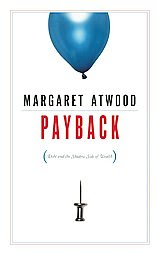
Payback

Instead of reading the book, I downloaded the audio and listened to the Massey Hall Lecture series Payback:  Debt and the Shadow Side of Wealth, by Margaret Atwood. The content was originally delivered in a series of lectures, and besides, it was easier to download it from the iTunes store than go to the library.

This was Virginia's pick for the Book Babes.  I've been reading a lot lately and wanted to give my eyes a rest. The original idea was to make my daily commute more interesting and listen in on the subway on the ride home, but I gobbled up the whole series end-to-end on Sunday afternoon while I dusted & puttered around the house.

Atwood's voice is uniquely her own, whether printed on the page or spoken aloud. In Payback she examines literature, philosophy, history and environmental issues through the lens of debt.

I think my favourite was Lecture 5, when Scrooge Nouveau is visited by by Earth Day ghosts and repents his evil ways.  She manages to twist a view of history with a morality tale and presents some highly complex issues with accessible satire.
The Spirit of Earth Day Past takes him on a tour through history, where they discover how the Black Death, Irish Potato Famine and the Industrial Revolution created the economies of their time.  Earth Day Present takes him to the bottom of the sea where overfishing is destroying the ocean floor, to the Arctic where the thawing tundra is releasing immense clouds of methane gas.  "Can't you stop all this," moans Scrooge.  "International laws... are hard to achieve in this area because no one can agree on what's fair.... "  The worst offending countries often owe money to the richer countries, and much of the destruction is fueled by debt.   The combined income of the 25 million richest individuals on the planet is equal to that of the poorest 2 billion.  Earth Day Future first takes the form of a Cockroach before morphing into a Futures Trader, sharing an optimistic Green utopia driven by citizens who lent money to their governments and where the debts of poor nations have been forgiven.  Scrooge asks how probable this view of the future will be and we are not surprised when we hear the ghost's answer. But it is a more pleasing view than the world where everything has been turned into money, and there is nothing left to eat.
Here she is speaking with Alan Gregg about Payback:

Monday, September 28, 2009

Erotics

One of the perks of having a son in university are the ideas he brings home for discussion. I found myself reading over his shoulder as he was writing a paper on erotics from one of his texts, Why Study Media? by Roger Silverstone.

The premise being that pleasure is a problem in the sense that:
Pleasure, excitement, sensation, these are constantly offered but seldom delivered; unconsummation is the norm....We spend a lot of time in front of the television set watching our favourite programs, but yet we often feel less than satisfied with the result... For our thinking is still constrained... by the separation of mind and body, and by the priority given to the definition of the human as a rational creature. As a result we can think about thinking well enough, but feeling is altogether another story... The erotic escapes. Shame and reason conspire to repress it.
I guess it would be oversimplifying to say that something truly erotic is something that sparks a deep connection; not just sexually charged.

The passage reminded me about the title of a podcast I listened to called, The Erotic Embrace of Life and Meditation. It was a Buddhist Geeks' podcast/interview with Shinzen Young about his attempts to balance intense practise and daily meditation as a Buddhist novitiate, alongside his day job in construction. It is not often the two paths intersect and it made for a lively discussion about how one way of life can inform the other, bringing insights that might not otherwise come when life is spent in solitude.

I was doing a Google image search of erotics to see if I could find something for this post, and there are certainly no shortage of pornographic images. Interspersed there are some great images of erotic sculptures at Hindu temples. But for deeply stirring erotics, I think Georgia O'Keefe is at the top of my list! (above is Red Canna).

Wednesday, May 27, 2009

Disguised

A recent podcast from the New Yorker Fiction section was entertaining me on my way to work this morning. Nathan Englander read Isaac Bashevis Singer’s “Disguised” and discussed it with The New Yorker’s fiction editor, Deborah Treisman.

Here is how the story begins: two young Jews marry. She is only 17, and he is still so young he doesn’t yet have any whiskers. A few months later, the young man leaves his bride behind without a word. Under Jewish law, the wife cannot remarry without a death certificate or divorce papers, so this is a life sentence of loneliness for our heroine, Temeril. Months later, after no word about her husband, the young girl sets out to track him down. It turns into an odyssey as years pass and the young girl turns into a young woman. In a foreign land, she recognizes a face in a street. A woman, with fuzz on her cheeks, who looks familiar... the stranger is so startled at seeing Temeril she drops the eggs in her arms and runs in the opposite direction. Could it be her husband after all these years?

That’s when my iPod conked out, so I had to wait for the conclusion.

Divorce. Gay marriage. Transvestitism. Not topics you would expect from Singer, although sex is a frequent theme. And cross-dressing was something he talked about in Yentle.

Wow. What a story! If you want to know how it ends, go visit http://www.newyorker.com/fiction.

I can tell you it is well worth the trip!

Thursday, April 16, 2009

Fanny Howe


Fanny Howe has been announced as the winner of the $100,000 Ruth Lilly Poetry Prize for lifetime achievement.

How exciting! I've been reading from her collection, Selected Poems for the past two weeks! I heard an interview with her via podcast at the Poetry Foundation and had to go out and get her book after hearing her voice.

In a 2004 interview with the Kenyon Review, Howe said this about her work: "If someone is alone reading my poems, I hope it would be like reading someone's notebook. A record. Of a place, beauty, difficulty. A familiar daily struggle."

Here are some favourites from that book...

*
I won't be able to write from the grave
so let me tell you what I love:
oil, vinegar, salt, lettuce, brown bread, butter,
cheese and wine, a windy day, a fireplace,
the children nearby, poems and songs,
a friend sleeping in my bed —

and the short northern nights.

*
Moon ink is too bright to read.

You run your fingers over the print
and get some sense.

But then you lose it too.
It swims in a pool of logic

that you can't disprove
because it doesn't move.

*

Into the forest I went walking — to get lost.

I saw faces in the knots
of trees, it was insane, and hands
in branches, and everywhere names.

Throughout the elms
small birds shivered and sang
in rhyme.

I wanted to be air, or wind — to be at ease
in outer space but in the world
this was the case:

Human was God's secret name.

*

Saturday, February 28, 2009

The Moth


Sometimes laugh-out-loud funny, sometimes sad, always thought-provoking. "The stories are true stories told from the storytellers' lives and must be told live, without notes."
http://www.themoth.org/ has featured hundreds of people from all walks of life. Firefighters, sleepwalkers, voodoo priestesses, philosophers, "everyday people," and famous names like Malcolm Gladwell, Erica Jong and John Turturro.
Podcasts are available at iTunes, with new stories uploaded weekly. There are Story Slams, the Main Stage and the Annual Moth Ball, all designed to help us remember just how extraordinary the ordinary can really be.

Wednesday, January 28, 2009

Last Night


If you want to hear an amazing short story, please check out this New Yorker podcast.

You can either get it through iTunes or the New Yorker site. Truly, it is incredible. Maybe I was just in an unusually receptive mood, but honestly, I can't remember a short story that has such memorable impact since the first time I read Raymond Carver.

Great rhythm, great twists and turns.

So go to iTunes, do a search for New Yorker Fiction and then scroll down the list. What you are looking for is
author: James Salter, story "Last Night" read by Thomas McGuane
release date, 1/9/2009
length is 33 minutes for the story and conversation

Enjoy!
If you do listen, let me know what you think.....